Storage & Ripening
How to Store Fruit: The Complete Fridge vs Counter Guide
Which fruits belong in the fridge, which on the counter, and how to keep produce fresh for longer.
Claire Moreau · September 20, 2026 · 9 min read
Storage & Ripening
Learn how to freeze berries, bananas, mangoes, stone fruit and more without clumps or freezer burn — plus how long frozen fruit keeps.
By Claire Moreau, Registered Dietitian & Senior Food Researcher · Updated October 5, 2026 · 9 min read · Fact-checked
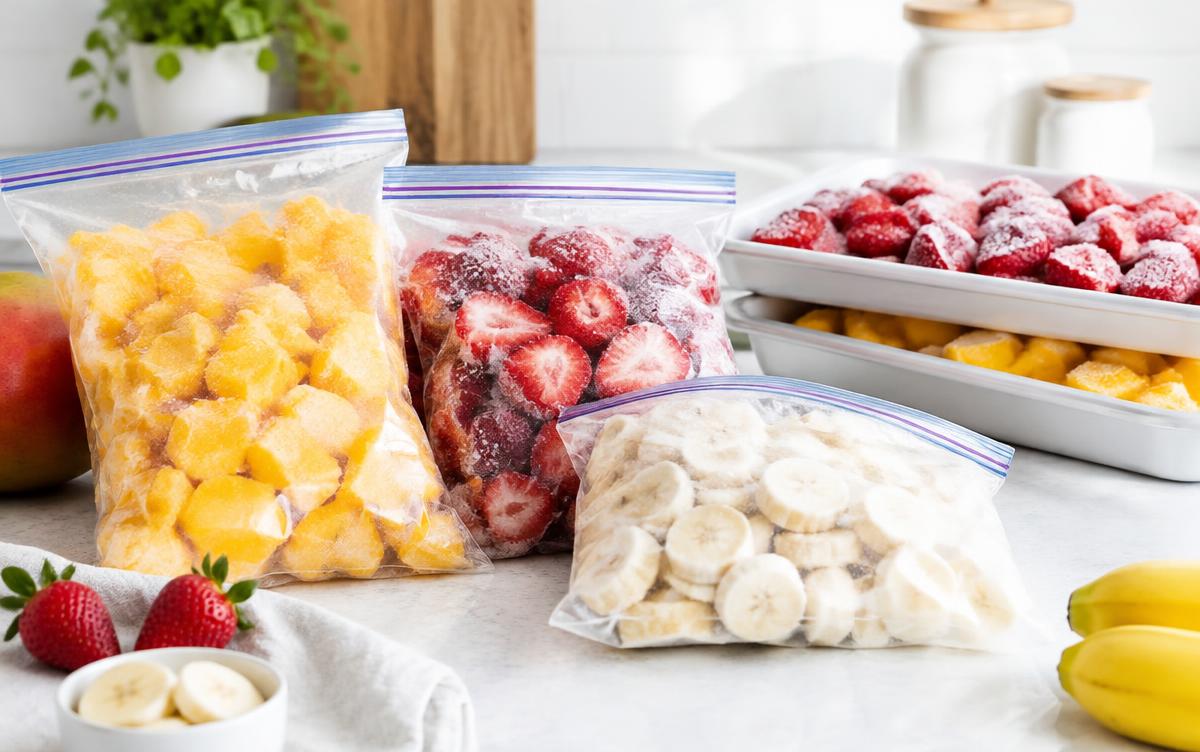
Freezing is one of the simplest ways to stop fruit going to waste. Overripe bananas, a bargain box of peaches, or the last of the summer berries can all be saved for months with a few minutes of preparation. Done badly, though, freezing leaves you with a solid brick of fruit coated in ice crystals. This guide explains the method that works for almost every fruit, the exceptions, and how to use frozen fruit well.
Freezing slows the enzymes and microbes that cause fruit to ripen and spoil. It does not kill most bacteria, and it does not stop every chemical change, but at −18 °C (0 °F) the process becomes slow enough that fruit stays safe indefinitely and good-quality for many months.
The main enemy of frozen fruit is ice crystal growth. Water inside the fruit expands as it freezes and ruptures cell walls, which is why thawed fruit is softer than fresh. Freezing quickly and keeping temperatures steady keeps crystals small and texture better.
Tray freezing (sometimes called open freezing) prevents fruit pieces from sticking together:
Bananas: peel first — frozen banana skins are very hard to remove. Slice into coins for smoothies or freeze halves for baking. Overripe, heavily spotted bananas are ideal because they are at their sweetest.
Berries: freeze whole. Hull strawberries first and halve large ones. Do not wash raspberries until just before freezing, and dry them very gently.
Mango, pineapple and melon: cut into cubes. Melon becomes watery when thawed, so use it frozen in smoothies or sorbets.
Peaches, nectarines, plums and apricots: halve, pit and slice. To prevent browning, toss slices in a little lemon juice or a solution of ascorbic acid (vitamin C powder). Peaches can be peeled by blanching in boiling water for 30 seconds then plunging into iced water.
Apples and pears: these brown quickly and soften a lot, so they are best frozen cooked, as a purée or stewed fruit, rather than raw slices.
Citrus: segments freeze poorly, but juice and zest freeze very well. Freeze juice in ice cube trays for portioned use.
Some fruits lose so much texture that freezing is rarely worth it for eating raw. Whole grapes are an exception — they become a pleasant frozen snack — but watermelon, citrus segments and whole apples turn mushy. Avocados can be frozen as a purée with lemon juice for dips but not as slices for salads. Fruits with very high water content are generally best used frozen, straight from the freezer, in blended drinks.
Freezer burn appears as dry, pale or leathery patches. It happens when moisture escapes from the fruit's surface and the exposed area oxidizes. Frozen fruit with freezer burn is safe to eat but tastes flat.
To prevent it, remove as much air from bags as possible — a drinking straw can suck out the last pocket — use thick freezer-grade bags or rigid containers, and avoid frequently opening the freezer door. A full freezer also holds its temperature more steadily than an empty one.
Frozen fruit stays safe at a constant −18 °C, but quality declines over time. As a guide:
Most frozen fruit works best when used directly from frozen. Add it straight to smoothies, porridge, muffins and crumbles, or simmer it into sauces. For baking, toss frozen berries in a spoonful of flour so they do not sink or bleed color into the batter.
If you need thawed fruit, defrost it in the fridge overnight in a bowl to catch the juice, which is full of flavor. Do not refreeze fruit that has fully thawed at room temperature, as the texture will deteriorate further and it may have warmed enough for bacteria to multiply.
Freezing preserves most nutrients well. Some vitamin C is lost over long storage, but frozen fruit is often as nutritious as fresh fruit that has been stored for several days.
No. Sugar was traditionally used to protect texture and color, but tray freezing without sugar works well for most home uses.
Yes, if the jars are freezer-safe and you leave at least 2 cm of headspace for expansion.
Generally yes, but food safety agencies have linked some imported frozen berries to outbreaks. Where advised in your country, boil frozen berries for one minute before serving to vulnerable people.
This article is for general information only and isn't a substitute for professional medical advice. See our disclaimer.
Storage & Ripening
Which fruits belong in the fridge, which on the counter, and how to keep produce fresh for longer.
Claire Moreau · September 20, 2026 · 9 min read
Fruit Nutrition
Blueberries, raspberries, strawberries and blackberries compared: fiber, vitamin C, polyphenols, and how to eat more of them on a budget.
Claire Moreau · October 8, 2026 · 9 min read